
Brynn & Joe were fertile, but the risk of passing a genetic disease to a child meant infertility treatment was the safest way to have a family
Like many fertile couples, Brynn and her husband, Joe, didn’t think they would have any trouble getting pregnant. They always knew they wanted to have two children, so they decided in 2023 that it was time to start their family.
Working as postpartum nurse for a hospital, Brynn was well aware of the challenges of pregnancy, including achieving it. She went to her OB-GYN as a patient for preconception counseling and agreed to undergo preconception genetic testing. The object is to identify genetic issues that can affect one’s ability to have a healthy pregnancy and a healthy child.
The result was surprising to Brynn and Joe: Brynn tested positive as a carrier of the genetic disorder muscular dystrophy. The would-be fertile parents faced a stark decision.
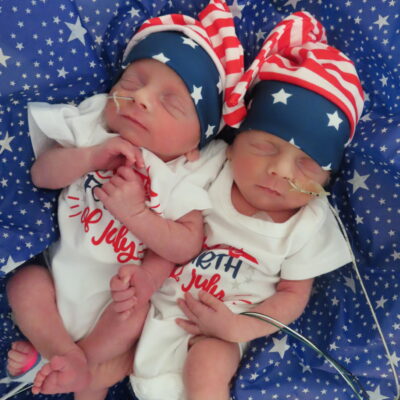
Fertile for pregnancy, but could they take the chance of passing muscular dystrophy to their child?
“I didn’t know I was a carrier for muscular dystrophy,” says Brynn. “I was really surprised.” Some people can be carriers and have symptoms but not have the disease. Brynn did not have the disease and had no symptoms.
She relates that her high-risk OB-GYN was very blunt in helping her and her husband make the decision, asking her: “Knowing that there’s the risk that you could outlive your child, can you do that?”
“I said I could not; I can’t watch my child struggle and eventually pass away,” says Brynn. “I knew we had a way to prevent that. I knew that IVF with PGT was an option, so that’s what we decided to do.”
IVF with PGT was their choice, but at which fertility clinic?
Brynn knew about in vitro fertilization (IVF) from her nursing background and learned more about that option along with PGT (preimplantation genetic testing) after her diagnosis. PGT can be performed on an embryo created through IVF to check its genetic health before implanting it for pregnancy and childbirth.
The couple lives in Knoxville, Tennessee, and researched fertility clinics there. They found clinics that performed IVF but not PGT. Brynn’s OB-GYN gave her names of prospective clinics outside of Knoxville, including Tennessee Reproductive Medicine (TRM) in Chattanooga, about 100 miles and a two-hour drive away.
After checking out TRM online, they decided to make the trip and give the clinic a try.
Good experiences with the fertility treatment at TRM, despite the travel time
Joe worked fulltime, so Brynn, who worked three or four days a week, had to do the driving by herself much of the time. “It was close to two hours to get there. And a lot of times I had to drive all the way down there for about a 10-15 minute appointment or just some lab work, and then I’d have to turn around and come back up here. It was hard at times,” says Brynn, adding that it was more financially feasible to do monitoring and labs at TRM than pay more for those services in Knoxville.
Brynn saw both doctors at TRM, Dr. Jessica Scotchie and Dr. Rink Murray. “Dr. Murray did my egg retrieval and my transfer. I love both of them; they were wonderful.”
Fertile among infertility patients, both depending on IVF
Brynn spent a lot of time around other TRM patients who had infertility issues, which she says was difficult for her being naturally fertile. “TRM did all my lab work and checking my hormones and everything, and I had no fertility issues. So, we weren’t like the other IVF patients there doing it for infertility issues. We did IVF just for the genetic component.”
Though Brynn had general knowledge about IVF and worked in obstetrics, like the other TRM patients, she was nervous about doing IVF. “But the doctors and staff were really helpful, being really informative, and I felt very comfortable with them,” she says.
“There’s always that chance that it doesn’t work. So that was always my fear, and I had never been pregnant before. They were encouraging that everything looked good and that it was going to work. And I was definitely very happy that it did.”
PGT enhanced with DNA profile for four embryos
Their IVF resulted in four embryos, which then needed to undergo PGT. Helping ensure accuracy of PGT-M for a single genetic disease, muscular dystrophy in this case, the genetics lab establishes which genetic markers on the chromosome are linked to the healthy gene and which to the disease-causing gene in that family.
This helps embryologists determine the pattern of genetic markers an IVF embryo needs to be healthy. Such embryos undergo an enhanced version of normal PGT.

More muscular dystrophy in the family
Creating this genetic profile meant testing Brynn’s mother and father for muscular dystrophy. Her mom’s test came back negative, but her father’s was positive for muscular dystrophy.
“Using my dad’s DNA and mine that were both positive, the lab put together a DNA profile and compared that to each of our embryos,” says Brynn. “We ended up with one boy embryo with muscular dystrophy, one girl embryo as a carrier, and then one healthy boy and one healthy girl embryo.”
Implanting a single embryo that became natural twins
Joe and Brynn decided to implant the one boy embryo, which is generally recommended when circumstances are favorable for a single healthy pregnancy. Known as elective single embryo transfer (eSET), this is done to avoid the potential health risks to mother and child of a multiple pregnancy (twins or more).
“We implanted the one embryo, and it split naturally, ending up being monozygotic dichorionic diamniotic twins,” says Brynn. “Usually identical twins are monochorionic-monoamniotic, where they share one placenta and amniotic sac or monochorionic-diamniotic where they share one placenta but have different amniotic sacs. Dichorionic-diamniotic twins each have their own placentas and amniotic sacs.”
Twins arrive early as premature babies
After 6 weeks of pregnancy, Brynn graduated from TRM to the care of a high-risk OB-GYN (because of the twins). “The pregnancy went really well. But the twins decided to come early, and I went into preterm labor at 32 weeks and four days in,” says Brynn. “I had them at 32 weeks and five days.”
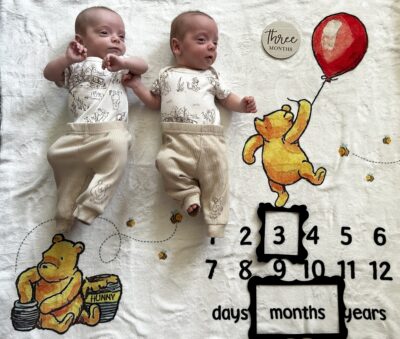
At the time of the interview for this story, the twins, Atticus Fount and Oliver Scott Blankenship, were four months old, two months adjusted for their early birth. “They’re doing really well. Having two at the same time is kinda crazy but we love it, and we always wanted to have two children.”
Brynn and Joe have started the process to donate their healthy female embryo to TRM. “We want to donate her to the clinic for someone else to be able to have a healthy baby that can’t,” says Brynn.
Expert Treatment. Total Commitment. TRM.

At Tennessee Reproductive Medicine, you’ll find a team of professionals dedicated to delivering the highest quality of compassionate fertility care.